


Demand response, in the context of the power grid, refers to programs designed to incentivize electricity users to voluntarily modify their consumption during peak demand or grid stress events. This approach is increasingly crucial as artificial intelligence (AI) data centers like the planned OpenAI campus in Georgia, which can curtail up to 1,000 megawatts become major energy consumers and potential grid stabilizers. OpenAI's agreement to reduce power draw during emergencies is pioneering a model for proactively integrating AI infrastructure with grid management, a framework with growing importance for ensuring reliable power in an AI-driven future.
That commitment sits at the center of the Grid Protectors Program, which OpenAI announced on November 2, 2026 as a national initiative designed to align AI infrastructure expansion with the operational realities of the power grid. Rather than treating electricity as an afterthought to be purchased wherever it's cheapest, the program treats compute campuses as flexibleGrid Protectors Program, which OpenAI announced on November 2, 2026, as a national initiative designed to align AI infrastructure expansion with the operational realities of the power grid. Rather than treating electricity as an afterthought to be purchased wherever it's cheapest, the program treats compute campuses as flexibleGrid Protectors Program, which OpenAI announced on November 2, 2026, as a national initiative designed to align AI infrastructure expansion with the operational realities of the power grid. Rather than treating electricity as an afterthought to be purchased wherever it's cheapest, the program treats compute campuses as flexibleGrid Protectors Program, which OpenAI announced on November 2, 2026, as a national initiative designed to align AI infrastructure expansion with the operational realities of the power grid. Rather than treating electricity as an afterthought to be purchased wherever it's cheapest, the program treats compute campuses as flexibleGrid Protectors Program, which OpenAI announced on November 2, 2026, as a national initiative designed to align AI infrastructure expansion with the operational realities of the power grid. Rather than treating electricity as an afterthought to be purchased wherever it's cheapest, the program treats compute campuses as flexibleGrid Protectors Program, which OpenAI announced on November 2, 2026, as a national initiative designed to align AI infrastructure expansion with the operational realities of the power grid. Rather than treating electricity as an afterthought to be purchased wherever it's cheapest, the program treats compute campuses as flexibleGrid Protectors Program, which OpenAI announced on November 2, 2026, as a national initiative designed to align AI infrastructure expansion with the operational realities of the power grid. Rather than treating electricity as an afterthought to be purchased wherever it's cheapest, the program treats compute campuses as flexibleGrid Protectors Program, which OpenAI announced on November 2, 2026, as a national initiative designed to align AI infrastructure expansion with the operational realities of the power grid. Rather than treating electricity as an afterthought to be purchased wherever it's cheapest, the program treats compute campuses as flexibleGrid Protectors Program, which OpenAI announced on November 2, 2026, as a national initiative designed to align AI infrastructure expansion with the operational realities of the power grid. Rather than treating electricity as an afterthought to be purchased wherever it's cheapest, the program treats compute campuses as flexible customers large, predictable loads that can bend when the system needs them most.
The idea, as OpenAI frames it, is straightforward: a compute campus is a big, steady customer that can bend. On most days it uses power the grid has spare, which helps pay for lines and substations that cost the same whether demand is high or low. On the hottest or coldest days it backs off. The company's own analogy is a restaurant in a vacation town that needs regulars to cover the off-season. "We are proposing to be that regular customer," OpenAI wrote in its announcement.
What the Grid Protectors Program Actually Does
The Grid Protectors Program establishes a framework for utilities to collaborate with OpenAI on planning and operating compute infrastructure that supports advanced AI workloads. Rather than signing standard industrial power agreements and walking away, OpenAI commits to location-specific operating arrangements that specify how much demand each campus can reduce, how quickly it can reduce that demand, and for how long.
According to the company's announcement covered by Blockchain.News, these arrangements are designed to support grid reliability while helping protect consumer electricity costs. The program acknowledges that large-scale AI compute infrastructure requires massive electricity consumption, and that concentrated demand from compute facilities can create upward pressure on rates for households and businesses.
"Families and small businesses should not be asked to subsidize a compute campus's electricity needs," OpenAI wrote. That statement, direct and unadorned, captures the program's core argument: AI expansion should be coordinated with grid capacity planning rather than treated as a separate infrastructure challenge.
OpenAI has also pointed to potential technical tools that could support demand flexibility: on-site generation, storage, batteries, and power controls. The company is clear, however, that these measures are prospective rather than proven nationwide operating capabilities. Flexibility alone, OpenAI acknowledges, cannot replace investment in electricity supply and transmission.
The Georgia Pilot: Effingham County and Project Camellia
The Grid Protectors Program's first concrete commitment lives in Effingham County, Georgia, where OpenAI's planned campus represents the largest single industrial power commitment the state has seen. Georgia Power has estimated the campus will eventually draw approximately 3,200 megawatts a load comparable to a mid-sized city.
Under the terms of the 25-year agreement, approved by Georgia utility regulators in August 2026, OpenAI can be asked to reduce its draw by up to 1,000 megawatts during grid stress events. That flexibility is not theoretical. According to coverage by The Next Web, Georgia Power expects that deals with large flexible users like OpenAI will save customers approximately $950 million annually beginning in 2029 savings that flow from reduced need to build new generation capacity to meet peak demand.
"Georgia is our starting point," OpenAI has said, making clear that the Effingham County campus serves as proof of concept for a model the company intends to carry to every state where it builds compute infrastructure.
The financial structure of the Georgia deal includes a significant commitment from OpenAI: the company will pay the full cost of the power lines and electric service infrastructure needed to serve the campus. This arrangement, documented in explainx.ai's detailed breakdown of the 1,000 MW pledge, means that OpenAI not Georgia Power ratepayers absorbs the upfront infrastructure investment required to deliver electricity to the site.
For utilities, this changes the calculus considerably. Rather than absorbing the cost of grid upgrades to serve a speculative industrial customer, they receive a committed long-term partner that covers its own infrastructure entry costs and agrees to modulate its load during system emergencies.
Why Now: The Politics and Pressure of AI Power Demand
The Grid Protectors Program arrives at a moment of visible tension between AI infrastructure ambitions and public concern about electricity costs. Data center power bills have become a campaign issue and a local government concern across the United States, with communities pushing back against proposed facilities amid fears of rate increases and grid strain.
Congress has weighed making large electricity users pay for grid upgrades, and the White House has asked builders to sign a voluntary pledge covering their own power costs. Google and Nvidia have formed their own alliance to make data centers flex their power consumption. The regulatory environment is shifting toward expectation and in some cases, mandate that AI companies participate in grid management rather than simply consuming power.
OpenAI's program can be read as a preemptive response to that shifting landscape. By establishing demand response commitments before they are required, the company positions itself as a cooperative partner with utilities and regulators rather than a company that must be compelled to participate. The announcement explicitly frames the initiative as a way to work within existing power systems rather than around them.
According to Emergent's coverage of the program launch, the initiative also includes provisions for demand response protocols that allow compute campuses to adjust power consumption during grid stress events a technical mechanism that gives utilities a direct lever to manage system stability rather than relying solely on supply-side responses like activating peaker plants.
The timing also reflects a practical reality: the company needs reliable power access to execute its own growth plans. Building compute campuses in power-constrained regions without a coordination framework risks delays, regulatory friction, and public backlash that could stall or block projects entirely. The Grid Protectors Program, whatever its altruistic framing, also serves OpenAI's operational interests.
How Flexible Demand Actually Works
To understand why the Grid Protectors Program matters, it helps to understand what flexible demand actually means for a compute facility. A data center running AI training workloads consumes electricity continuously. Shutting down entirely during a grid emergency is impractical and would undermine the very service the facility exists to provide.
But a large language model training run does not require peak performance at every moment. A compute campus can reduce its power draw in several ways: throttling non-critical workloads, deferring batch processing to off-peak hours, or drawing on on-site battery storage to reduce grid dependence during demand response events. The key is that the facility has load flexibility that a hospital or a residential neighborhood does not.
OpenAI's framework formalizes that flexibility as a utility resource. Under the Georgia agreement, when Georgia Power calls for a demand response event, OpenAI's Effingham County campus agrees to reduce its grid draw by up to 1,000 megawatts within agreed timeframes and for agreed durations. The arrangement is contractual, binding, and tied to specific technical parameters.
This is meaningfully different from a typical industrial power agreement, where a large customer simply draws what it needs and the utility manages the consequences. The Grid Protectors model makes the compute campus an active participant in grid operations a customer that can be turned down when necessary and that helps the utility avoid costly infrastructure investments that would otherwise be needed to serve peak demand.
The Economics: Who Pays for AI's Electricity
One of the most concrete elements of the Grid Protectors Program is OpenAI's commitment to cover infrastructure costs. In Georgia, this means paying for the power lines and service connections that bring electricity from the grid to the Effingham County campus. These costs which can run into hundreds of millions of dollars for a facility of this size are typically socialized across all utility customers in traditional rate cases.
By absorbing these costs itself, OpenAI removes a significant financial burden from Georgia Power ratepayers. The company also signs long-term contracts and provides financial assurances that could help protect other customers if projects are delayed, reduced, or canceled a risk mitigation provision that utilities have increasingly demanded as data center proposals have proliferated.
Georgia Power's projected savings of approximately $950 million annually from 2029 reflect the cumulative effect of multiple such agreements across the utility's large-load portfolio not savings attributable to OpenAI alone. But the Effingham County campus, as the largest single commitment, represents the most significant piece of that projection.
For consumers, the practical implication is that AI infrastructure expansion does not automatically translate to higher electricity bills. The Grid Protectors Program's structure with OpenAI covering infrastructure costs and providing demand flexibility is designed to ensure that the benefits of large industrial power agreements flow to utilities and their customers, not exclusively to the technology companies building data centers.
What This Means for Future Compute Campuses
OpenAI has not announced specific locations for campuses beyond Georgia, and the announcement did not specify a start date for broader deployment of the program. The company has said it will share additional commitments as arrangements with utilities are finalized.
What is clear is the model the company intends to replicate. Each future compute campus will operate under location-specific terms agreed with the relevant utility. Those terms will specify how much demand can be reduced, how quickly, and for how long. The technical mechanisms may vary on-site generation in one region, battery storage in another, workload scheduling in a third but the underlying principle remains consistent: OpenAI compute campuses will function as flexibleGrid Protectors Program participants, not passive power consumers.
For utilities evaluating AI company proposals, the Grid Protectors framework offers something tangible: advance visibility into compute demand, a structured mechanism for managing large loads, and a committed partner willing to cover infrastructure entry costs. This is a meaningfully different relationship than utilities have historically had with large industrial customers, who typically sought the cheapest power available with minimal obligations beyond payment.
According to CellCog's analysis of the program, the arrangements will differ by location, and OpenAI has committed to sharing additional commitments as they are finalized. The company has been explicit that the Georgia model is the template, not the limit.
The Broader Implications for AI and Energy
The Grid Protectors Program arrives as the debate over AI energy consumption intensifies. Data centers now represent one of the fastest-growing categories of electricity demand in the United States, and projections for future growth are substantial. The question of who pays for the grid infrastructure needed to serve that growth and who bears the cost when demand strains system reliability has become a central policy question.
OpenAI's approach sidesteps some of that debate by presenting a fait accompli: the company has agreed to terms in Georgia that demonstrate a willingness to pay its own way and contribute to grid stability. Whether that approach will be adopted industry-wide, or whether it represents a competitive differentiation that others will follow, remains to be seen.
What the program does establish is a framework contractual, measurable, and replicable for how AI companies and utilities can work together. The demand response commitments are specific: up to 1,000 megawatts in Georgia, with per-utility arrangements that specify performance parameters. The infrastructure cost commitments are clear: OpenAI pays to connect. The consumer protection framing is explicit: families and small businesses should not subsidize compute campuses.
That specificity matters. Abstract commitments to responsible energy consumption are easy to make and hard to verify. The Grid Protectors Program ties OpenAI to concrete obligations that utilities can enforce and that regulators can observe.
What This Means for OpenAI Readers
For readers evaluating how AI infrastructure companies are responding to grid constraints, the Grid Protectors Program offers a case study in proactive utility coordination. The Georgia pilot demonstrates that OpenAI is willing to make binding demand response commitments, cover infrastructure costs, and operate as a flexibleGrid Protectors Program participant rather than a passive power consumer. Whether this model will hold across different regulatory environments and utility frameworks remains an open question but the Georgia terms provide a concrete reference point for what that coordination looks like in practice.
The program also illustrates a broader shift in how large technology companies approach energy infrastructure. Rather than treating grid access as a commodity purchase, OpenAI is treating it as a partnership one that requires the company to absorb costs and accept operational constraints in exchange for reliable long-term power access and regulatory goodwill.
For readers tracking AI policy and energy regulation, the Grid Protectors Program is worth watching. The question of whether other AI companies adopt similar coordination models and whether regulators mandate such coordination industry-wide will shape the relationship between AI infrastructure and the power grid for years to come.
Where to Read Further
OpenAI's official announcement of the Grid Protectors Program, published November 2, 2026, is available at VFF's coverage of the launch. For a detailed breakdown of the 1,000 MW pledge and the Georgia deal structure, explainx.ai's explainer provides section-by-section analysis of the program's terms. The Next Web's coverage includes context on the broader political environment surrounding data center energy costs, including Congressional activity and the voluntary White House pledge. CellCog's analysis offers a concise summary of the program's mechanics and what to watch as additional commitments are announced.
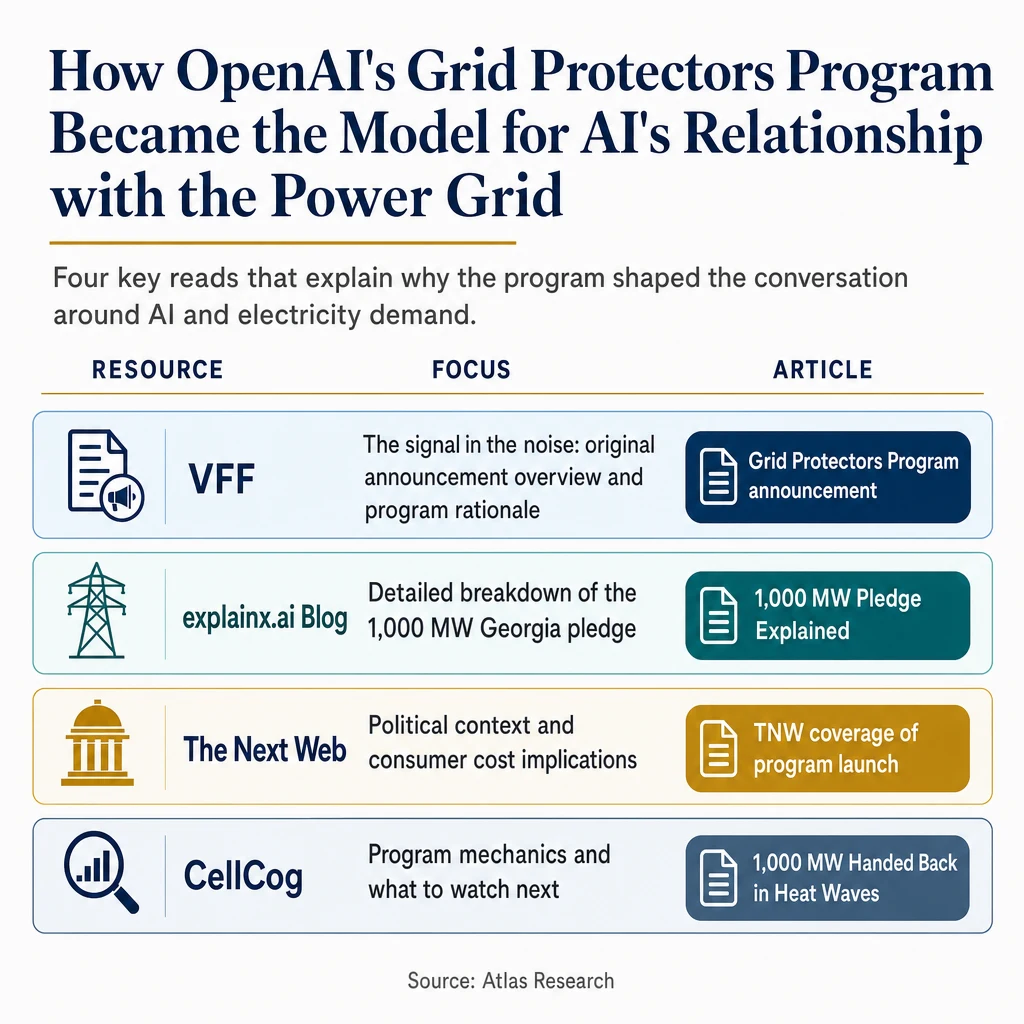
| Resource | Focus | URL |
|---|---|---|
| VFF - The signal in the noise | Original announcement overview and program rationale | Grid Protectors Program announcement |
| explainx.ai Blog | Detailed breakdown of the 1,000 MW Georgia pledge | 1,000 MW Pledge Explained |
| The Next Web | Political context and consumer cost implications | TNW coverage of program launch |
| CellCog | Program mechanics and what to watch next | 1,000 MW Handed Back in Heat Waves |