


Late on a Tuesday afternoon, an outdoor kitchen contractor in Maryland picks up the phone. The caller wants a quote on a basic BBQ island. Just the island. Maybe some counter space on the side. The contractor has spent fifteen years building complete outdoor living spaces with integrated plumbing, proper gas and electrical infrastructure, custom cabinetry, and appliances that turn a backyard into an extension of the home. But on this call, he finds himself explaining why a simple grill pad won't work with the infrastructure he installs. He's not selling what the caller wants. The caller isn't buying what he builds. Nobody is wrong, exactly. But the marketing that brought them together is broken.
This scene plays out in outdoor kitchen companies across the country, according to available industry materials. The businesses are built for premium, complete transformations. The marketing attracts people shopping for basic components. The result is a quiet drain on time, energy, and revenue that never shows up as a crisis but accumulates as a persistent drag on growth.
The good news is that this problem is solvable. It doesn't require abandoning what makes these companies valuable or competing down-market with basic patio contractors. It requires a different approach to marketing one that filters for the right buyers before they ever pick up the phone.
Diagnose the Lead Mismatch Before You Change Anything
The first step is honest inventory. Most outdoor kitchen companies don't have a lead shortage. They have a wrong-lead problem. Available industry materials describe this clearly: companies get plenty of inquiries, but those inquiries ask about grill pads while the business is built to sell complete outdoor living spaces.
Pull three months of incoming inquiries and categorize them by project scope. How many callers are asking for basic cooking surfaces versus complete outdoor rooms? How many mention integrated infrastructure plumbing, electrical, proper ventilation? How many are comparing quotes against the contractor down the street versus homeowners who already understand that a complete outdoor living transformation is a significant investment?
The goal isn't to feel bad about this gap. The goal is to understand the magnitude. A company that closes three complete outdoor living projects per month but fields fifteen grill-pad inquiries per week is spending enormous energy educating the wrong buyers. The mismatch isn't a failure of the sales team. It's a marketing signal that the messaging is attracting the wrong end of the market.
Available materials from hello.bz's outdoor kitchen marketing research frame this as a filtering problem. The outreach should be filtering for complete outdoor living buyers before they ever contact you. That starts with understanding who is currently being filtered in and who is being filtered out by the existing marketing system.
Understand Why Standard Marketing Advice Fails Premium Builders
Most marketing advice for outdoor living companies focuses on volume. More leads. More visibility. More traffic. For a basic patio company, this makes sense. You want as many quotes as possible to feed a numbers game. Close enough leads in sufficient quantity and the economics work.
But premium outdoor kitchen builders aren't commodity businesses. Available industry materials describe average projects at $25,000, $35,000, and $50,000 or more. These are complete transformations that take months of planning and execution. The buyers aren't comparing contractors on price alone. They're looking for someone who can design and build an integrated outdoor living space that matches how they want to live.
Volume-based marketing creates the wrong problem for this business model. More cheap leads means more time wasted on prospects who compare the premium builder to the contractor down the street. More tire-kickers asking for just a basic island. More people who want a patio company, not an outdoor living architect. The math that works for commodity businesses actively hurts premium builders.
The hello.bz analysis of lead mismatch puts it plainly: the real question isn't whether you can sell complete spaces. It's why your marketing keeps attracting the wrong end of the market. Answering that question requires letting go of volume-based thinking and embracing a different model entirely.
Map the Buyer Journey for Complete Outdoor Living Transformations
High-ticket outdoor kitchen buyers don't wake up one morning wanting a grill island. They dream about weekend gatherings in a fully equipped outdoor room. They imagine entertaining friends around a fireplace while dinner cooks on a professional-grade grill. They picture their family eating dinner outside on warm summer evenings, with refrigeration nearby and proper lighting setting the mood.
Available industry materials describe outdoor living as an emotion, not a feature list. The buyers are imagining the experience. They want the feeling of a complete outdoor living space, even if they don't yet have the vocabulary to describe what that requires.
This insight changes how you map the buyer journey. The homeowner who calls about a grill island often upgrades to a full outdoor room when they understand what's possible. But that conversation needs to happen during the research phase, before the estimate is written. Once a buyer has anchored on a budget for a basic island, expanding that conversation becomes much harder.
Map the journey from initial awareness through final project completion. Where do buyers go for inspiration? What questions do they ask before they call? What would help them understand that a complete outdoor living transformation is within reach? The answers to these questions become the content and messaging framework for marketing that attracts the right buyers.
Build Visual-First Campaigns That Show Complete Transformations
Outdoor kitchen buyers are visual. They want to see what their backyard could become. Available industry materials emphasize lifestyle proof images and videos that connect the project to real moments. Entertaining. Weekend gatherings. Family dinners outside.
Generic stock photos of grills and countertops don't create this connection. Neither do feature lists that describe specifications without evoking the experience. The campaigns that attract high-ticket buyers show the transformation. Before and after. The empty patio becoming a fully equipped outdoor living room. The family gathered around a fireplace as the sun sets. The professional-grade kitchen that makes outdoor entertaining effortless.
This visual-first approach requires investment in photography and videography that most outdoor kitchen companies haven't prioritized. But the return is significant. When a homeowner sees a complete outdoor living transformation that matches their dream, they self-qualify. They understand that this isn't a grill pad project. This is a months-long design and build engagement that will transform how they use their home. The leads that come in through visual-first campaigns arrive pre-sold on scope.
Capture the Spring Urgency Window Before Competitors Saturate
Most outdoor kitchen inquiries cluster between March and May. This is when homeowners start thinking seriously about outdoor projects. The weather warms. They spend more time in their backyards. They imagine what they could do with the space if it were properly equipped.
Available industry materials describe this as a marketing window. Companies that position campaigns to capture this window before competitors saturate the market gain significant advantage. Early-season promotions and warm-weather triggers create urgency before the market gets crowded with options.
But capturing the spring window requires work that starts in January or February. The homeowners who are ready to call in March have been researching since December. They've been browsing inspiration online, saving images to Pinterest boards, and talking with family about outdoor living plans. If your marketing isn't visible during that research phase, you're competing for their attention when they're already narrowing down their list of contractors.
A 12-month marketing plan that builds anticipation well before spring prevents the annual scramble. Instead of competing for the same buyers at the same time, you have a pipeline of pre-qualified leads ready to start conversations as soon as the weather turns.
Introduce Complete Project Scope During the Research Phase
The upsell starts in the initial conversation. Available industry materials make this explicit: the homeowner who calls about a grill island often upgrades to a full outdoor room. But that upgrade doesn't happen automatically. It requires staging the conversation to introduce refrigeration, pergolas, and fire features during the research phase before the estimate.
This isn't about pushing add-ons onto reluctant buyers. It's about helping homeowners understand the full scope of what's possible. Most homeowners don't know that outdoor kitchens can include proper refrigeration, integrated sinks, weather-resistant cabinetry, and heating elements that extend the season. They don't know that pergolas and fire features can create distinct zones within an outdoor living space. When they learn what's available, many choose to include more than they initially imagined.
The staging happens through content, not sales pressure. Blog posts that explore complete outdoor living design. Photo galleries that show the range of possible features. Case studies that walk through the decision-making process for previous clients. This content reaches buyers during the research phase, when they're still forming their vision. By the time they call, they're already thinking beyond the grill pad.
Build Referral Pathways from Design and Build Relationships
Available industry materials note that the best projects often don't come from Google searches. They come from referrals and design/build relationships. Homeowners who are ready for complete outdoor living transformations tend to trust the recommendations of friends, family, and design professionals over search engine results.
This means your online presence isn't capturing the buyers who are already looking for premium work. You're living off word-of-mouth while prospects who would be ideal clients search for someone else. The fix isn't to abandon online marketing it's to make sure your online presence is designed to attract referrals rather than random search traffic.
Build relationships with interior designers, landscape architects, and architects who work on high-end residential projects. These professionals regularly encounter homeowners who want to extend their living space outdoors. When they know a trusted outdoor kitchen builder, they refer. Create materials that make it easy for them to refer you portfolio books, project sheets, and clear communication about the types of projects you specialize in.
Common Mistakes That Keep Premium Builders Stuck
After years of working with outdoor kitchen companies, certain patterns emerge. These are the mistakes that keep premium builders attracting the wrong leads, even when they know something needs to change.
Mistake 1: Competing on price in the marketing. When your website leads with competitive pricing or emphasizes value propositions that focus on cost, you attract price-sensitive buyers. These buyers are comparing you against every other option, including basic patio contractors. Premium builders should never compete on price in their marketing. Compete on experience, design capability, and the completeness of the transformation.
Mistake 2: Using generic outdoor kitchen imagery. Stock photos of grills and islands look like every other outdoor kitchen company's website. They don't differentiate. They don't tell your story. Invest in photography of your actual completed projects, showing the full scope of what you build and the lifestyle moments your clients enjoy.
Mistake 3: Waiting until the estimate to discuss project scope. If you're introducing refrigeration, pergolas, and fire features for the first time during the estimate conversation, you've waited too long. The buyer has already anchored on a budget and a scope. Expanding that conversation feels like upselling, even when it's actually helping them get what they really want. Start the scope conversation in the research phase, through content and early conversations.
Mistake 4: Ignoring the research phase entirely. Most marketing focuses on the moment of conversion when a homeowner is ready to call. But the research phase, when buyers are forming their vision, is where the most important decisions get made. If your marketing isn't visible during research, you're not influencing which contractors make the shortlist.
Mistake 5: Treating all leads as equal. A lead asking for a grill pad quote is not the same as a lead asking about a complete outdoor living transformation. They require different conversations, different estimates, and different time investments. Treat them differently in your marketing, and you'll spend your estimate time on projects that match what you actually build.
Why This Matters for hello.bz Readers
This isn't a niche problem. Across the outdoor living industry, premium builders are losing time and energy to a marketing mismatch that drains revenue without anyone noticing it as a crisis. The companies that solve this problem building marketing systems that attract complete outdoor living buyers before they ever call gain a significant competitive advantage. They spend less time educating wrong-fit prospects. They close higher-value projects. They grow capacity-matched, without the chaos of chasing every inquiry that comes through the door.
The shift doesn't require abandoning what makes these companies valuable. It requires a different lens on marketing one that sees lead quality as more important than lead quantity, and buyer fit as more important than search rankings. For outdoor kitchen companies built to sell complete transformations, this reframe is the foundation of sustainable growth.
Where to Read Further
For a deeper dive into the lead mismatch problem and the marketing framework designed to address it, explore hello.bz's outdoor kitchen marketing research, which documents the specific challenges premium builders face when attracting the wrong end of the market.
The analysis of why standard marketing fails premium outdoor kitchen builders provides additional context on why volume-based approaches create the wrong problem for complete outdoor living companies.
For inspiration on the range of features and finishes available in custom outdoor kitchen design, the Stoll Industries outdoor kitchen portfolio showcases modular and custom options that help homeowners envision complete transformations.
To understand how premium outdoor kitchen builders communicate their value proposition, Lazo Outdoors' custom outdoor kitchen approach demonstrates how design-focused messaging attracts homeowners ready for complete backyard transformations.
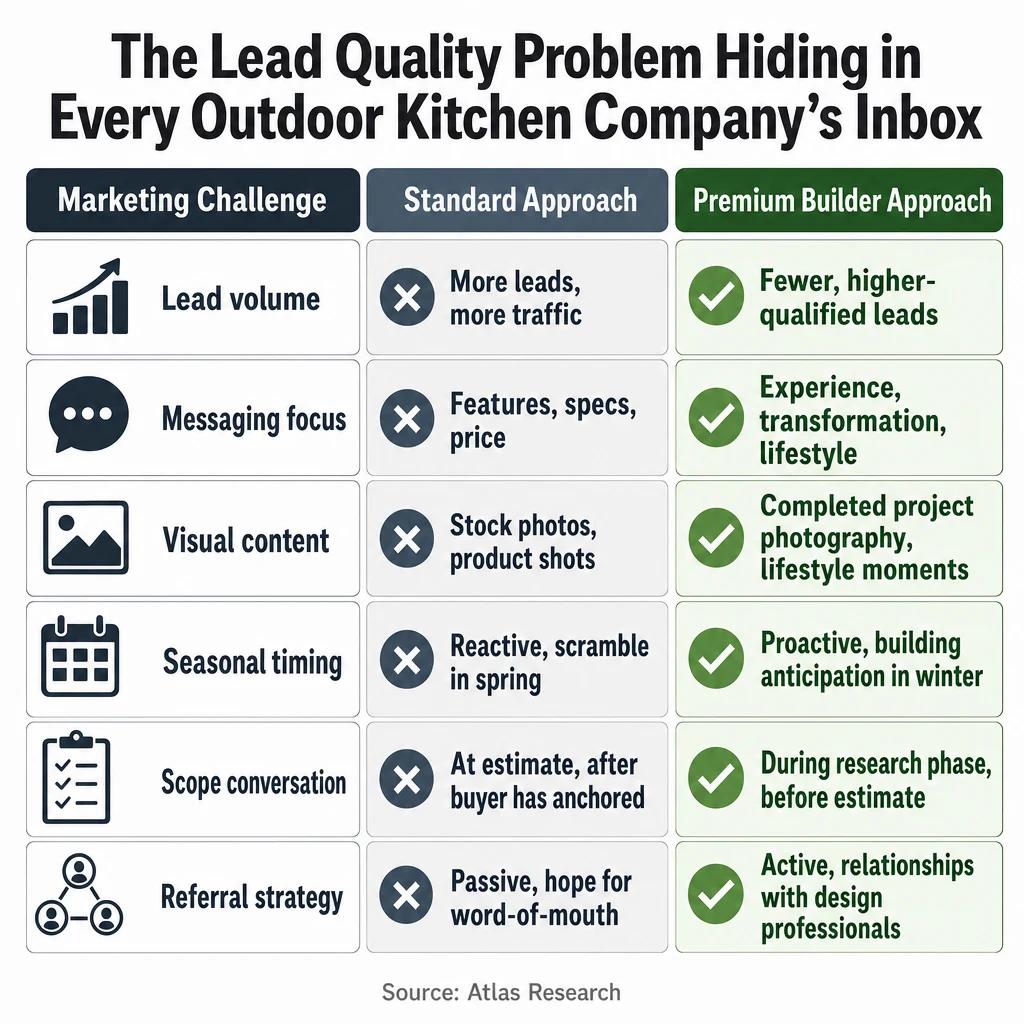
| Marketing Challenge | Standard Approach | Premium Builder Approach |
|---|---|---|
| Lead volume | More leads, more traffic | Fewer, higher-qualified leads |
| Messaging focus | Features, specs, price | Experience, transformation, lifestyle |
| Visual content | Stock photos, product shots | Completed project photography, lifestyle moments |
| Seasonal timing | Reactive, scramble in spring | Proactive, building anticipation in winter |
| Scope conversation | At estimate, after buyer has anchored | During research phase, before estimate |
| Referral strategy | Passive, hope for word-of-mouth | Active, relationships with design professionals |